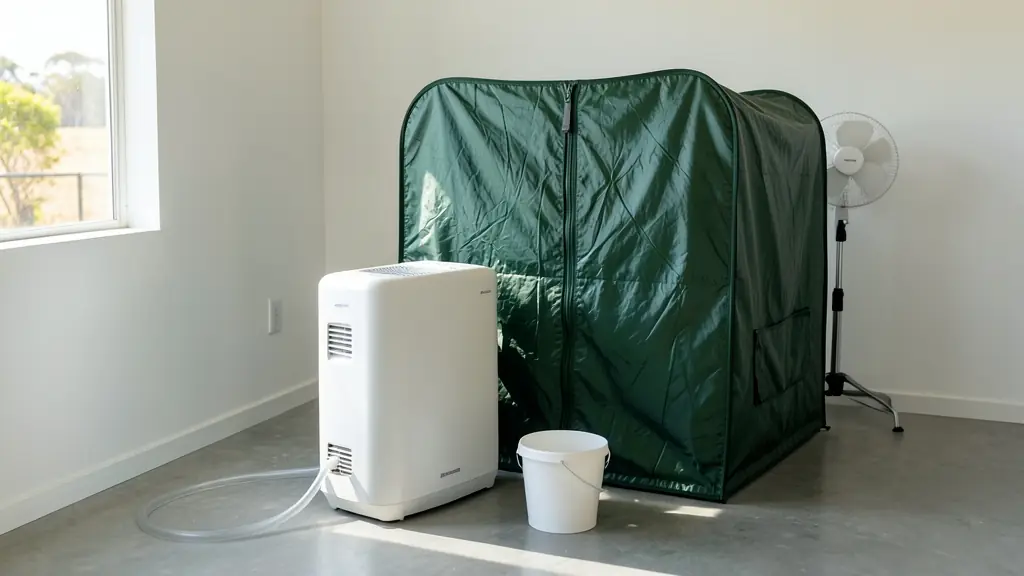
Plants take up water through their roots and give most of it back as vapour, so a closed room, tent or tunnel gets steadily wetter. A grow room dehumidifier removes that moisture before mould, bud rot and fungal disease take hold. This page covers why humidity peaks, how lights-off spikes work, sizing to the water you feed, air movement, drains, and how to keep it general and sensible. Send one request and independent suppliers in your area quote you directly.
Why humidity climbs in a grow room
Plants lose water through their leaves, a process called transpiration. Most of the water you feed comes back out as vapour. Add wet soil, damp floors and a closed room, and humidity rises fast. When the lights go off the room also cools, so the same water in the air gives a higher relative humidity, often the worst moment of the day.
Too high a humidity encourages mould, mildew and bud rot. Too low stresses the plants. Growers often use a vapour pressure deficit (VPD) chart, which combines temperature and humidity, to pick a target for each growth stage.
Sizing to the water you feed
A good rule is to size the dehumidifier to the water fed to the plants, because nearly all of it ends up in the air. A room that is fed 10 litres a day needs to be able to remove about that much on top of what leaks in from outside.
- Note the daily water volume at your peak growth stage.
- Allow extra for a damp floor, a humid climate or a coastal location.
- Check capacity at the warm temperature of your room, not just the test figure.
- Remember that a stronger light adds heat and increases transpiration.
See dehumidifiers for how litres a day are rated.
Air movement, drains and placement
A dehumidifier works best with moving air. Use small fans to keep air moving through the canopy and across the room, so pockets of damp air do not form. Place the unit outside a tent where possible, or in the room around it, with space on all sides for airflow.
A drain is essential because a grow room can fill a tank in hours. Ask for a continuous drain hose or a built-in pump. Check the unit is allowed to run at the temperatures you hold, and that it restarts after a power cut or load shedding.
Greenhouses, tunnels and dry stores
The same principles apply in a greenhouse, a tunnel near Pietermaritzburg or a nursery: ventilation does the heavy lifting, and a dehumidifier helps when the outside air is as wet as the inside, as in a misty KwaZulu-Natal Midlands morning. Seed stores, drying rooms and packing sheds also benefit from controlled humidity, and a simple hygrometer at canopy height shows when the room drifts out of range.
For larger sites, ask about industrial dehumidifiers or desiccant units for cold nights. We only deal with the humidity side; check the rules that apply to what you grow.
What to put in your request
- Room, tent or tunnel size in metres
- Daily water volume fed to the plants at peak
- Lights-off temperature and the humidity you want
- Drain hose, pump and noise needs
- Your town, power supply and when you need it
Grow Room Dehumidifiers for homes, rentals, businesses and industry
- Homeowners and tenants: dries a spare room or garage used for houseplants, seedlings or a small indoor garden
- Landlords, agents and body corporates: helps a property with an indoor garden keep humidity from damaging walls and ceilings
- Offices, schools and clinics: dries a small plant room or a rooftop propagation space in a commercial building
- Warehouses, archives and storage: controls humidity in a converted unit used for propagation or storing dried produce
- Factories and food plants: holds humidity steady in a processing room for herbs, flowers or dried produce
- Growers, nurseries and farms: removes the water plants release, so mould, bud rot and fungal disease stay down
- Hotels, gyms, spas and pools: dries a kitchen garden tunnel or a herb room on a lodge or wine estate
- Insurers, assessors and restoration firms: dries a grow room or a tunnel after a leak, a flood or a burst irrigation line
- Builders, HVAC engineers and contractors: specifies drains, power and ducting for a purpose-built grow room or nursery
Frequently asked questions
Do you sell dehumidifiers yourselves?
No. We are a free quote request service. We pass your request to independent suppliers and hire firms in your area, and they quote you directly.
What humidity should a grow room hold?
It depends on the crop and the stage of growth, and on the temperature. Many growers use a VPD chart to choose a target. A supplier cannot set it for you, but can match a unit that holds the range you need.
Why does humidity spike when the lights go off?
The room cools, so the same amount of water vapour gives a higher relative humidity. Plants also keep releasing water. A humidistat on the dehumidifier helps hold the target through the night.
Do I still need fans and ventilation?
Yes. Moving air stops damp pockets forming around leaves. The dehumidifier removes the water, and the fans spread the dry air through the room.
Grow Room Dehumidifiers by province and city
- Johannesburg
- Pretoria
- Centurion
- Midrand
- Sandton
- Randburg
- Roodepoort
- Krugersdorp
- Randfontein
- Germiston
- Boksburg
- Benoni
- Kempton Park
- Alberton
- Vanderbijlpark
- Vereeniging
- Durban
- Pinetown
- Pietermaritzburg
- Richards Bay
- Newcastle
- Ladysmith
- Gqeberha (Port Elizabeth)
- East London
- Kariega (Uitenhage)
- Mthatha
- Cape Town
- Bellville
- Paarl
- Stellenbosch
- George
- Worcester
- eMalahleni (Witbank)
- Middelburg
- Secunda
- Mbombela (Nelspruit)
- Rustenburg
- Brits
- Klerksdorp
- Potchefstroom
- Mahikeng
- Polokwane
- Tzaneen
- Kimberley
- Upington
- Bloemfontein
- Welkom
- Sasolburg