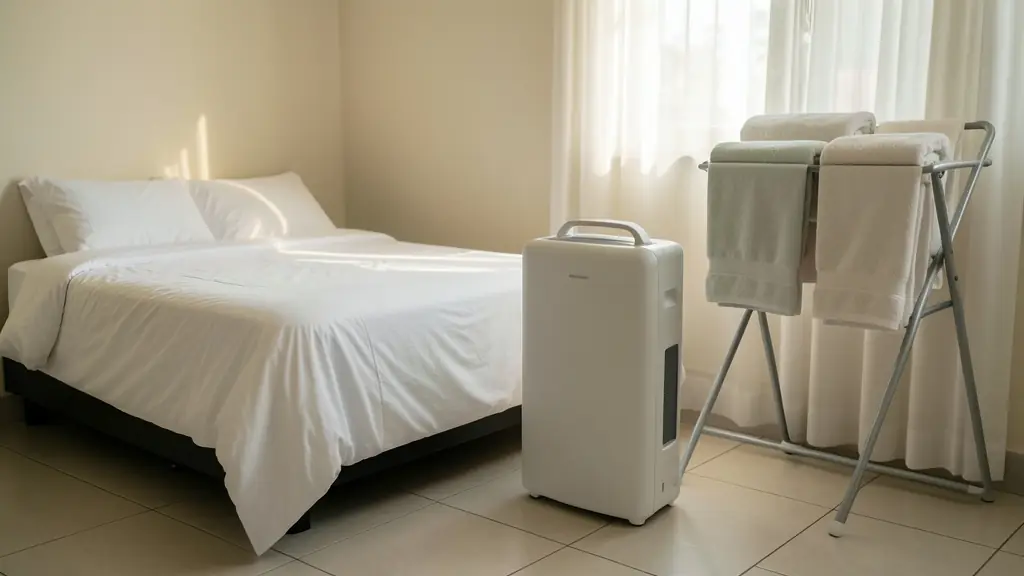
A dehumidifier for a room is a portable unit you roll or carry into the bedroom, lounge or laundry that stays damp. It plugs into a normal plug point, collects water in a tank, and switches itself on and off at the humidity you set. This page covers capacity by room size, noise for bedrooms, tank versus drain, drying washing indoors, running cost and load shedding. Send one request and independent suppliers near you quote directly.
Capacity for the size of room
Litres a day is the number to compare, but read the small print: it is measured at warm, very humid test conditions, so a real room in cool weather gives less. As a rough guide, a small bedroom or flat is often served by a 10 to 16 litre unit, a lounge or a larger damp room by 20 litres or more, and a whole small house by a bigger unit placed centrally.
Wetter rooms, more people, indoor washing and gas heaters all push the load up. When in doubt, a slightly larger unit with a humidistat cycles off sooner and often does the job more quietly. See the general dehumidifiers page for how sizing works.
Noise, tank and drain
Bedrooms need a quiet unit, so check the decibel rating and ask whether there is a night or low-fan mode. A compressor and fan will never be silent, but a good one fades into the background.
- Tank: a bigger tank means fewer trips, and a full-tank cut-off protects the floor.
- Drain hose: a continuous drain to a sink, shower or outside lets you leave it for days.
- Pump: a built-in pump lifts water up and over a window sill or across a passage.
- Castors and handle: useful in a house with several rooms to dry.
Drying washing and load shedding
In a wet Cape winter or a humid Durban summer, drying washing indoors puts litres of water into the air. A laundry mode on a home dehumidifier runs the fan harder and holds a lower humidity, so a clothes airer in a closed room dries far faster than it would on its own. Keep the door shut and the room warm if you can.
Ask whether the unit restarts by itself after a power cut. Some stay off until you press the button, which defeats a humidistat when load shedding cuts the power overnight.
Where to put it and what it costs to run
Put the unit in the damp room, a little away from walls and curtains, with doors and windows closed. Upstairs or downstairs matters less than where the moisture is made. Clean the filter every few weeks, empty the tank daily or use the drain, and keep the coil clear.
Running cost is watts x hours run, divided by 1000, times your tariff per kWh, so check the wattage on the plate. For a short job such as drying a flat after a leak, consider dehumidifier hire.
What to put in your request
- Room size and ceiling height in metres
- Which room: bedroom, lounge, laundry or whole flat
- Whether you dry washing indoors on most days
- Noise limits, for example a unit for a bedroom at night
- Tank, drain hose or pump, and your town for delivery
Home Dehumidifiers for homes, rentals, businesses and industry
- Homeowners and tenants: keeps a bedroom or lounge dry through winter and helps washing dry indoors without mould
- Landlords, agents and body corporates: gives a damp rental flat a unit that tenants can run without a technician call-out
- Offices, schools and clinics: dries a small office, a consulting room or a stockroom that smells musty after rain
- Warehouses, archives and storage: protects a small storeroom or archive cupboard where a full industrial unit is too big
- Factories and food plants: dries a small packing room, a staff changing area or a control room
- Growers, nurseries and farms: dries a small seed store or drying room off the main growing area
- Hotels, gyms, spas and pools: freshens a guest room or a guesthouse laundry that stays damp in the wet season
- Insurers, assessors and restoration firms: adds a small unit to dry one room, a cupboard or a passage after a minor leak
- Builders, HVAC engineers and contractors: dries a freshly plastered bedroom or a snag-list room before the owner moves in
Frequently asked questions
Do you sell dehumidifiers yourselves?
No. We are a free quote request service. Your request goes to independent suppliers and hire firms that serve your area, and they quote you directly. You decide whether to buy, hire or ask more questions.
Will a home dehumidifier work in winter?
A compressor unit works best in a warm, humid room. In a cold room its capacity drops and the coil can ice up, although many models defrost automatically. For a cold, unheated space ask about a desiccant model.
Can one unit dry the whole house?
A single portable unit can help a small flat or an open-plan home if doors stay open and it sits centrally. A larger house with damp rooms at opposite ends usually needs a unit per area, or a ducted system.
How often do I empty the tank?
In a very damp room a tank can fill in a day. A continuous drain hose or a built-in pump removes the chore. The unit should stop itself when the tank is full.
Home Dehumidifiers by province and city
- Johannesburg
- Pretoria
- Centurion
- Midrand
- Sandton
- Randburg
- Roodepoort
- Krugersdorp
- Randfontein
- Germiston
- Boksburg
- Benoni
- Kempton Park
- Alberton
- Vanderbijlpark
- Vereeniging
- Durban
- Pinetown
- Pietermaritzburg
- Richards Bay
- Newcastle
- Ladysmith
- Gqeberha (Port Elizabeth)
- East London
- Kariega (Uitenhage)
- Mthatha
- Cape Town
- Bellville
- Paarl
- Stellenbosch
- George
- Worcester
- eMalahleni (Witbank)
- Middelburg
- Secunda
- Mbombela (Nelspruit)
- Rustenburg
- Brits
- Klerksdorp
- Potchefstroom
- Mahikeng
- Polokwane
- Tzaneen
- Kimberley
- Upington
- Bloemfontein
- Welkom
- Sasolburg