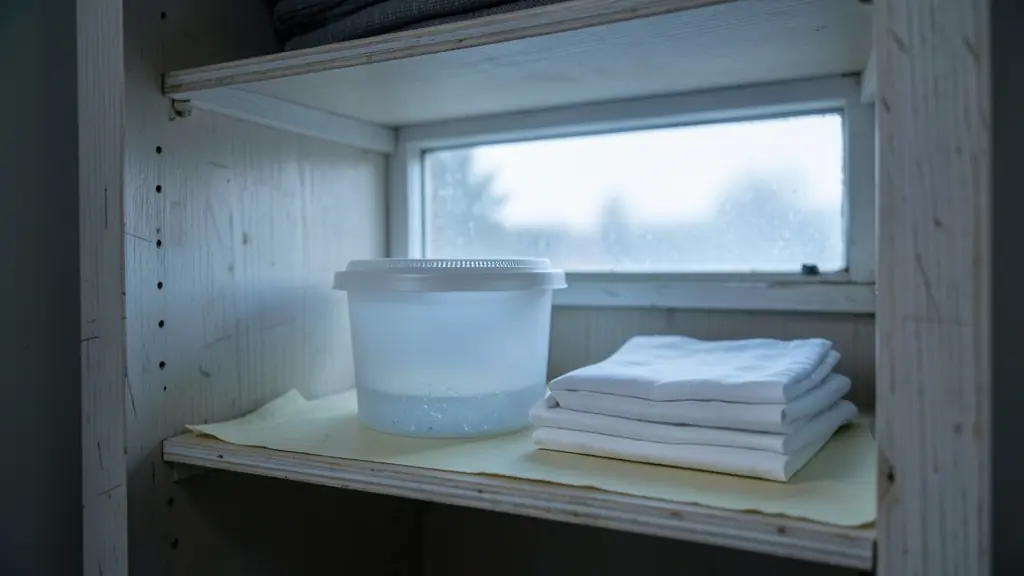
A moisture absorber is a tub or hanging bag of calcium chloride crystals that pulls water vapour from the air and collects it as a salty liquid underneath. It needs no electricity, costs little and does a decent job in a cupboard, a car, a boat, a caravan or a holiday home that stands closed for weeks. It will not dry a damp room: for that you need a dehumidifier. Tell us what you want to protect, and we pass your request to independent suppliers who quote you directly.
How the crystals work
Calcium chloride is a salt that attracts water. Air passes through the perforated lid, the crystals take up the moisture and slowly dissolve into a brine that drips into the lower chamber. When the crystals are gone and the chamber is full, the tub is finished.
The tub works only on the air in its immediate space, so it suits small, closed spaces. Open a cupboard door all day and the absorber is trying to dry the whole house.
Where a tub helps and where it does not
A tub is a sensible choice when the volume is small and the air does not change much:
- built-in cupboards, wardrobes and linen shelves
- a car, caravan or boat that is parked for days
- a holiday flat or cottage left closed between visits
- a store cupboard, a small garage shelf or a safe room
If walls are running with condensation or a room smells musty, a tub will barely register. Dry the room first, as covered under dehumidifiers for mould, and use tubs for the corners that stay stuffy.
How many tubs and how long they last
A common starting point is one tub per cupboard or one per small closed room, and more where it is very humid, such as the KwaZulu-Natal coast in summer. How long one lasts depends on the humidity and the size of the tub, anything from a few weeks to a few months. Check the tub every couple of weeks and replace or refill it when the crystals have dissolved.
Refill packs are cheaper than new tubs, so ask your supplier about them. Many suppliers also sell hanging bags for tight spots; see wardrobe and cupboard dehumidifiers. A busy household can save money by buying a larger tub for a bigger cupboard rather than several small ones, and by keeping one spare refill in the house so the cupboard is never unprotected. Write the date you started a tub on the shelf edge, so you know how long it has lasted and can judge the right replacement interval for your climate.
Using them safely
The liquid is salty and corrosive. Keep tubs out of reach of children and pets, stand them on a stable shelf where they cannot tip, and never let the brine touch wood, metal or fabric, as it can stain and corrode. When the chamber is full, pour the liquid down a drain, rinse the tub and follow the maker's instructions for the next refill. Do not hang a tub above clothes, and keep it away from electronics.
What to put in your request
- What you want to protect: a cupboard, car, boat or closed room
- How many cupboards or small rooms, and roughly how big
- Whether you want tubs, hanging bags or refill packs
- How humid the place is, for example near the coast
- Delivery address or whether you will collect
Moisture Absorbers for homes, rentals, businesses and industry
- Homeowners and tenants: tubs in built-in cupboards, wardrobes and a spare room that stays shut
- Landlords, agents and body corporates: a tub in each cupboard of a flat that stands empty between tenants
- Offices, schools and clinics: a tub in a store room, filing cupboard or a small records room
- Warehouses, archives and storage: tubs on shelves for small stock lines, spare parts and boxed paper
- Factories and food plants: tubs in a control cabinet room or tool store, as a small extra
- Growers, nurseries and farms: tubs in a seed cabinet or small dry store on the farm
- Hotels, gyms, spas and pools: tubs in linen cupboards and in closed guest rooms out of season
- Insurers, assessors and restoration firms: tubs to protect salvaged items stored after a leak or a flood
- Builders, HVAC engineers and contractors: tubs left in a finished, closed unit to keep new joinery dry
Frequently asked questions
Do moisture absorbers really work?
How do I know when to replace the crystals?
Is the liquid dangerous?
Do you sell moisture absorbers yourselves?
Moisture Absorbers by province and city
- Johannesburg
- Pretoria
- Centurion
- Midrand
- Sandton
- Randburg
- Roodepoort
- Krugersdorp
- Randfontein
- Germiston
- Boksburg
- Benoni
- Kempton Park
- Alberton
- Vanderbijlpark
- Vereeniging
- Durban
- Pinetown
- Pietermaritzburg
- Richards Bay
- Newcastle
- Ladysmith
- Gqeberha (Port Elizabeth)
- East London
- Kariega (Uitenhage)
- Mthatha
- Cape Town
- Bellville
- Paarl
- Stellenbosch
- George
- Worcester
- eMalahleni (Witbank)
- Middelburg
- Secunda
- Mbombela (Nelspruit)
- Rustenburg
- Brits
- Klerksdorp
- Potchefstroom
- Mahikeng
- Polokwane
- Tzaneen
- Kimberley
- Upington
- Bloemfontein
- Welkom
- Sasolburg