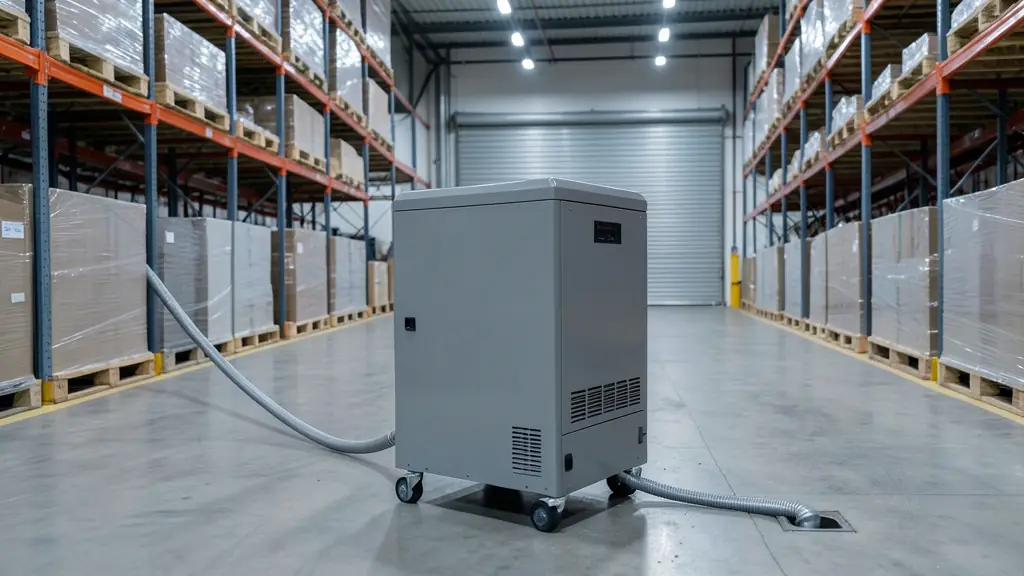
An industrial dehumidifier does the work of a home unit many times over, in a warehouse, an archive, a food plant or a building site. These machines are rugged, sit on castors, carry big tanks or drain pumps, and often run for days at a time. This page covers where they are used, how to think about capacity, drains, ducting and power, buying versus hiring, and servicing. Send one request and independent suppliers and hire firms in your area quote you directly.
Where industrial units are used
Typical jobs are warehouses and distribution centres holding paper, cardboard, textiles or electronics, archives and records stores, food and drink plants, pharmaceutical stores, printing works, cold rooms where ice builds up, water treatment plants and pump stations, and construction drying of screeds and plaster. Ships, shipping containers, mines and tunnels also need them. In a port city such as Durban or Cape Town, stock sitting near the harbour can pick up damp quickly in humid weather, which is why many logistics parks run units all year.
Where the target is very low, such as a cold store or a process room, a desiccant dehumidifier is often the better choice. For drying after a leak or flood see water damage restoration.
Capacity, drains and ducting
Capacity is not just a floor area. It depends on the building volume, the temperature, how often doors open, what is stored and how much water the process adds. Larger jobs are sized by an HVAC engineer or an experienced supplier from the moisture load, not from a catalogue number alone.
- Castors and handles: to move the unit through doors and between bays.
- Drain or pump: a continuous drain to a floor drain, or a pump that lifts the water to a gully.
- Ducting: hoses or fixed ducts that move dry air to where it is needed.
- Controls: a humidistat, a timer, and sometimes a link to a building management system.
Power and hazardous areas
Many commercial units run on single-phase power, but bigger machines may need three-phase supply. Check the plug point, the cable length and the breaker before delivery, and ask for the power draw in watts or amps if you run on a generator or an inverter during load shedding.
Fitting a fixed unit needs a registered electrician with a certificate of compliance. For hazardous areas such as some chemical stores or fuel areas, ask for units certified for that zone. Do not use a standard unit there.
Hire or buy, and servicing
For a short job, such as a new floor screed, a flooded store or a one-off event, dehumidifier hire is cheaper than owning. If the damp is permanent, buying or a long contract makes sense. Ask what a service contract covers: filters, coils, drain pumps, refrigerant checks and call-outs.
Refrigerant work must be done by a technician registered for it. A planned service before the wet season keeps units running when you need them. See dehumidifier repairs.
What to put in your request
- Floor area and ceiling height of the space in metres
- What is stored or made, and the humidity you need
- Power available: single-phase, three-phase or generator
- Drain access, ducting needs and whether the space is a hazardous area
- Buy or hire, for how long, and delivery address
Industrial Dehumidifiers for homes, rentals, businesses and industry
- Homeowners and tenants: dries a large basement, a double garage or a wine cellar that a home unit cannot manage
- Landlords, agents and body corporates: dries the parking basement or common areas of a block where condensation drips onto cars
- Offices, schools and clinics: protects a records room, a server room or an archive floor from damp air
- Warehouses, archives and storage: keeps stock, packaging and racking dry and stops condensation on a cold concrete floor
- Factories and food plants: holds humidity steady in food, pharmaceutical, printing and electronics areas
- Growers, nurseries and farms: dries a packing shed, a curing room or a cold store used for produce
- Hotels, gyms, spas and pools: dries a large kitchen, a laundry, a cellar or a plant room serving a hotel
- Insurers, assessors and restoration firms: dries a flooded building quickly with several units, air movers and moisture readings
- Builders, HVAC engineers and contractors: dries screeds, plaster and finishes so painting and flooring can go ahead on time
Frequently asked questions
Do you sell dehumidifiers yourselves?
No. We are a free quote request service. We pass your request to independent suppliers and hire firms that serve your area, and they quote you directly.
How do I size a unit for a warehouse?
Give the floor area, ceiling height, what is stored, the temperature and how often doors open. A supplier or HVAC engineer will work out the moisture load and recommend a capacity, often more than one unit.
Can an industrial dehumidifier run on a generator?
Often yes, if the generator can handle the start-up load. Ask for the power draw and the starting current, and say whether you will use a generator or an inverter.
Is hire or buying better?
Hire suits short jobs, trials and seasonal peaks. Buying suits permanent damp. Many suppliers offer both, so ask for each quote and compare the cost over a year.
Industrial Dehumidifiers by province and city
- Johannesburg
- Pretoria
- Centurion
- Midrand
- Sandton
- Randburg
- Roodepoort
- Krugersdorp
- Randfontein
- Germiston
- Boksburg
- Benoni
- Kempton Park
- Alberton
- Vanderbijlpark
- Vereeniging
- Durban
- Pinetown
- Pietermaritzburg
- Richards Bay
- Newcastle
- Ladysmith
- Gqeberha (Port Elizabeth)
- East London
- Kariega (Uitenhage)
- Mthatha
- Cape Town
- Bellville
- Paarl
- Stellenbosch
- George
- Worcester
- eMalahleni (Witbank)
- Middelburg
- Secunda
- Mbombela (Nelspruit)
- Rustenburg
- Brits
- Klerksdorp
- Potchefstroom
- Mahikeng
- Polokwane
- Tzaneen
- Kimberley
- Upington
- Bloemfontein
- Welkom
- Sasolburg