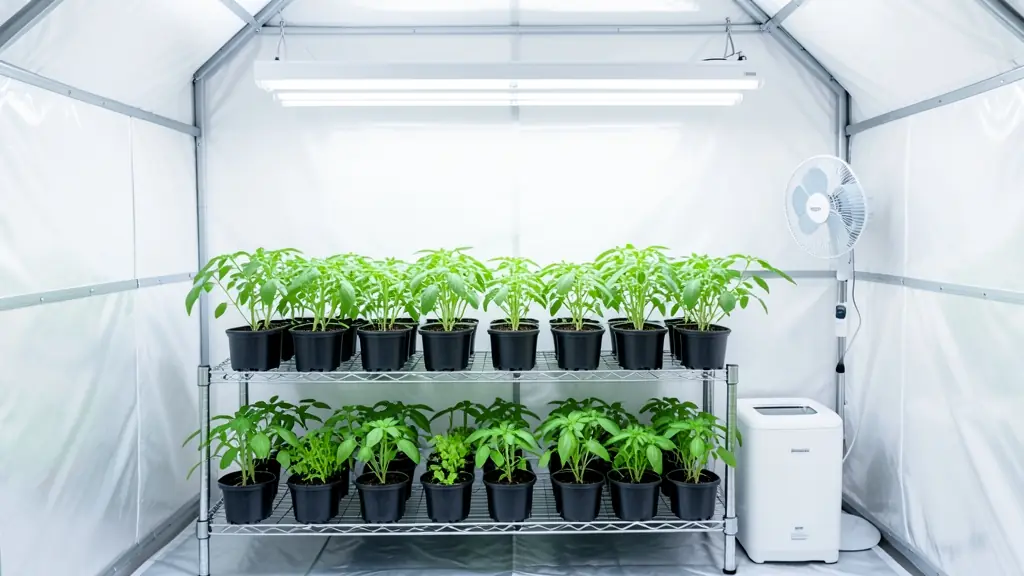
Growers often talk about vapour pressure deficit (VPD) rather than humidity, because it says how strongly the air pulls water out of the leaves. Too low, and plants transpire slowly, take up fewer nutrients and get mould and mildew; too high, and they close their pores and stress. VPD brings temperature and humidity together into one number, in kilopascals (kPa).
How VPD is worked out
VPD is the difference between the water vapour pressure at the leaf surface, where the air is saturated, and the vapour pressure of the room air. The calculator works out saturation vapour pressure with the Magnus formula at the leaf temperature and at the air temperature, multiplies the second by the relative humidity, and takes the difference.
Leaves are usually a little cooler than the air because they evaporate water, often by 1 to 3°C under LEDs and more under strong airflow. An infrared thermometer pointed at the top leaves gives the real figure. If you don't know it, 2°C cooler is a common starting point.
Ranges growers commonly use
These are common grower ranges, not rules; check the advice for your crop and cultivar.
| Stage | VPD | Why |
|---|---|---|
| Cuttings and seedlings | 0.4 to 0.8 kPa | Few roots yet, so the leaves must not lose water fast |
| Vegetative growth | 0.8 to 1.2 kPa | Steady transpiration pulls up water and nutrients |
| Flowering and fruiting | 1.2 to 1.6 kPa | Drier air keeps grey mould out of dense flowers and fruit |
The humidity that gives these figures depends on the temperature, so the calculator above works out the target humidity for the temperature you enter.
Holding it there
Humidity in a grow room peaks when the lights go off: the temperature drops, the plants keep transpiring, and the relative humidity can jump by 15 to 20% within an hour. That is when grey mould and powdery mildew get going. A grow room dehumidifier sized for the water the plants give off, with a humidistat and a drain to waste, holds it steady. A rough rule is that plants give off almost all the water they are fed, so the litres you irrigate a day are a good guide to the litres a day the unit must remove. In a cold tunnel at night, a desiccant unit keeps working where a compressor unit would not.
Frequently asked questions
What is a good VPD?
How do I lower VPD?
Why does humidity spike when the lights go off?
How many litres a day should a grow room dehumidifier remove?
More calculators and guides
- Dehumidifier size calculatorLitres a day for a room from its size and how damp it is
- Dew point and condensation calculatorWhen a window or wall will run wet, and the mould risk on it
- Relative and absolute humidity calculatorRelative to absolute humidity, and the water in a room's air
- Dehumidifier running cost calculatorkWh and rands a month at your tariff, and the load on an inverter
- Ideal humidity levels guideTarget humidity for every kind of room, and a reading checker